About One Fair Wage
One Fair Wage is the national restaurant and service worker organization, led by Saru Jayaraman. We organize tipped and subminimum-wage workers across the country, run the deepest research program on tipped work in the United States, and lead the Living Wage For All coalition.
What we do
OFW is a worker-led organization with three main programs: direct services for restaurant and service workers (English For Restaurant and Service Workers classes, low-cost Just Safe Food certification, and worker rights information and referrals), policy and campaigns to end the subminimum wage and raise the floor, and the High Road Restaurants program with operators paying one fair wage. We co-lead the Living Wage For All coalition pursuing the federal $25 minimum wage.
How we got here
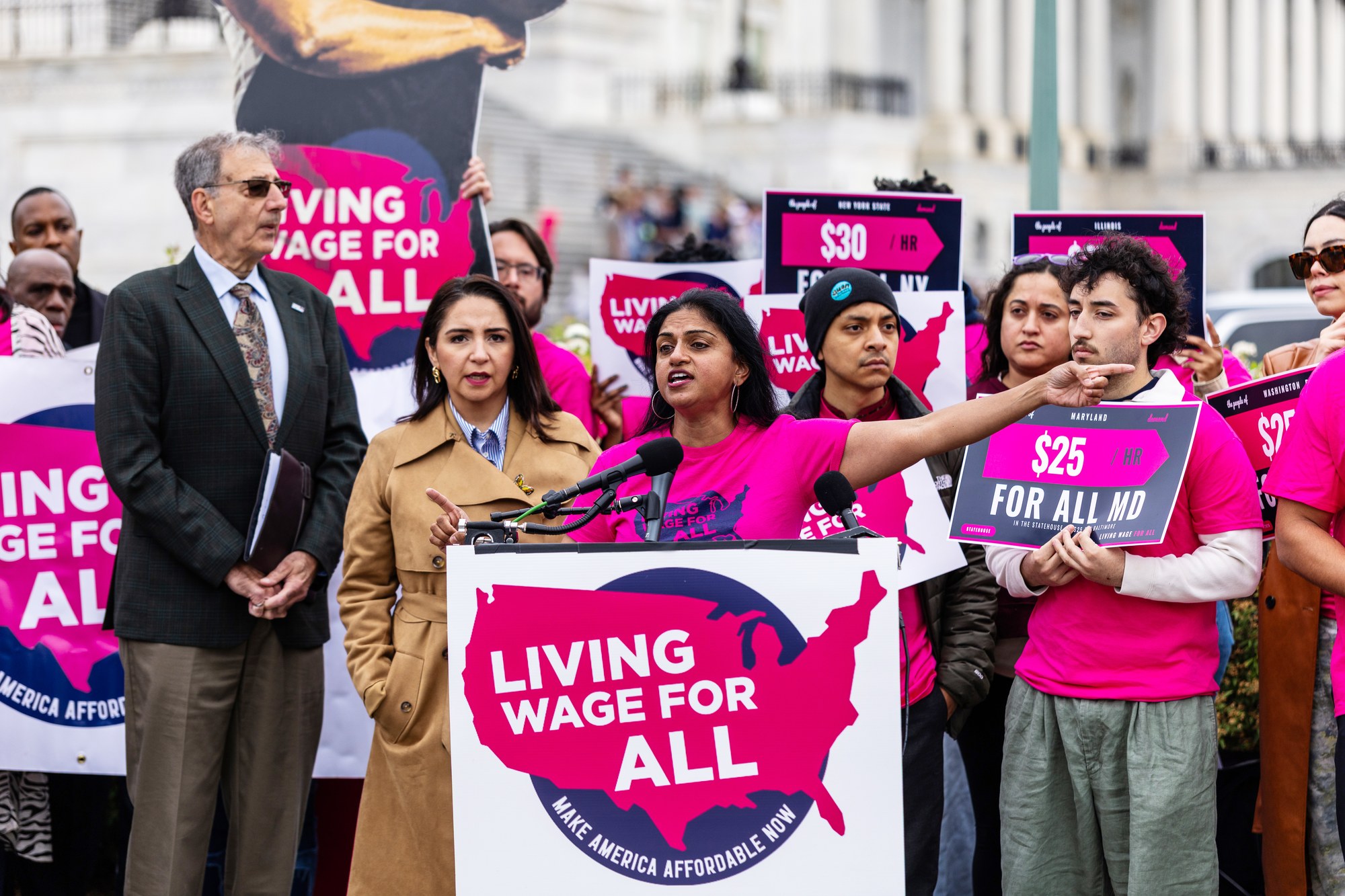
OFW grew out of organizing in the wake of 9/11 with restaurant workers displaced from Windows on the World. During the COVID-19 pandemic, OFW ran an Emergency Relief Fund that distributed direct assistance to service workers nationwide — more than 270,000 workers applied, and OFW later mobilized many of them to vote. From that beginning the organization has grown into a national network with 300,000 worker members and 1,000 high-road small-business restaurant employer partners. We won the votes that ended the subminimum wage in Washington D.C. (Initiative 82, 2022) and Chicago (One Fair Wage Ordinance, 2023) — wins the industry lobby has since fought to slow in both cities — and we are now co-leading the federal fight for the Living Wage For All Act (H.R.8555). Rep. Delia Ramirez introduced the bill in the 119th Congress and launched it publicly at the U.S. Capitol on April 28, 2026; it now has 32 House cosponsors as of September 2026 and a Senate companion led by Sen. Chris Murphy.
What We’ve Won
A decade of fights, from the first statewide ballot win to a federal bill in both chambers of Congress. The pattern repeats: workers win, the restaurant lobby gets it overturned, and workers win it back bigger.
Maine passes the first statewide One Fair Wage ballot measure. The legislature overturns it under National Restaurant Association pressure — and the votes are now on the record.
One Fair Wage wins on the ballot in Washington, D.C. (Initiative 77) and through the Michigan legislature after a 400,000-signature drive. Politicians overturn both. Both come back. The same year, OFW’s peer-to-peer voter program in Michigan drives a 300% turnout increase among low-wage worker voters.
The U.S. House passes the Raise the Wage Act — the first chamber of Congress to vote to end the tipped subminimum wage since Emancipation. One Fair Wage and One Fair Wage Action launch to scale the fight.
OFW convenes the first national gathering of workers from all nine subminimum wage sectors — and they vote to fight under one banner. That fall, OFW turns its relief list into an electorate: nearly 50,000 unlikely low-wage voters cast ballots in Michigan and Pennsylvania — thousands of them voting for the first time.
OFW moves roughly $30 million in pandemic relief: the Relief Fund raises $22 million in direct cash assistance — more than 270,000 workers apply — and High Road Kitchens moves $8 million to hundreds of mostly BIPOC-owned independent restaurants in seven states, seeding what becomes RAISE High Road Restaurants. Surveys of that base produce 50+ pandemic research reports and the “wage shortage, not worker shortage” argument that reframes the Great Resignation.
President Biden puts the Raise the Wage Act in his first COVID relief package, and it passes the House again. “Server for an Hour” puts Senator Schumer and dozens of members of Congress behind the counter in high-road restaurants. Saru Jayaraman’s One Fair Wage (New Press) and the documentaries Waging Change and The Great American Lie carry the story nationally.
Washington, D.C. wins again: Initiative 82 passes, ending the tipped subminimum wage 160 years after Emancipation. In Michigan, workers submit more than 600,000 signatures — nearly double the requirement — for a statewide wage measure.
Chicago passes the One Fair Wage Ordinance, phasing out the tipped subminimum wage in the city where it began — won after a decade of organizing by tipped-worker leader Nataki Rhodes and a cadre of women of color worker-leaders. (The Council paused the phase-out in 2026; the ordinance stands and workers are fighting to restore the timeline.) California signs SB 476, making employers rather than workers pay for food-handler cards and training time. Rhode Island makes serious wage theft a felony, championed by an OFW Action-endorsed legislator.
The Michigan Supreme Court restores the 2018 ballot win, ordering a full minimum wage with tips on top. Months later the legislature intervenes again, preserving a tipped subminimum wage — so Michigan workers are still fighting.
OFW convenes and launches Living Wage For All — now more than 100 labor, community, and civil rights organizations behind one demand: a wage you can live on, for every worker, no exceptions.
The Living Wage For All Act reaches both chambers of Congress — H.R. 8555 in the House with 32 cosponsors as of September 2026, and the Senate companion led by Sen. Chris Murphy. In Alameda County, a worker-led drive gathers more than 100,000 signatures and qualifies a measure that, if passed, would be the country’s first voter-enacted $30 minimum wage.
The next round is already underway. See where we’re fighting now →
Theory of change
OFW believes the most durable way to change an industry is to change who has power inside it. Three things make that real:
- Workers organize. Restaurant workers are the country’s largest non-union workforce. When 300,000 of them are connected to each other, to legal help, to training, and to one another’s state campaigns — they stop being isolated. That’s the foundation under everything else.
- The other side’s narrative breaks. The National Restaurant Association has spent four decades arguing that ending the subminimum wage will close restaurants. Our research and the data from the seven states that pay a full minimum wage with tips on top, and from D.C. and Chicago after their raises began, prove that’s false. When the data is undeniable, the policy follows.
- High-road operators build the alternative. 1,000 restaurants in our network already pay one fair wage. They’re the proof that the industry can run on a different model. They’re also our political shield: legislators can’t claim “all restaurants oppose this” when restaurants are at the table testifying for it.
State-by-state wins build momentum for the federal fight. The federal fight raises the floor everywhere. Worker services make the current system survivable while we change it.
The federal fight runs through a coalition we built for it. In 2025, OFW convened the Living Wage For All coalition — 100+ labor, faith, civil-rights, education, disability-rights, and immigrant-rights organizations — to turn the OFW state-by-state model into a multiracial national campaign. LW4A wrote the federal bill and runs the campaigns. See our Living Wage For All page for the full coalition story.
How we’re funded
OFW is a 501(c)(3) nonprofit supported by foundation grants, individual donors, and our member workers. We accept no funding from the restaurant lobby or its trade associations. Financial transparency: our 990 and annual reports are public on request. Donate to support our work →
Foundation support
OFW’s work is supported by philanthropic institutions backing workers’ rights, racial equity, and economic justice. A current list of foundation supporters is available on request at development@onefairwage.org.
Leadership