Living Wage
For All
In 2025, One Fair Wage convened and stood up Living Wage For All — a national coalition of 100+ organizations fighting for a livable wage floor across every state, every industry, and every kind of worker the federal minimum wage has left behind. LW4A is the broader movement around the OFW campaigns. Same fight. Wider table.
Why OFW stood up LW4A
One Fair Wage is, by design, a restaurant and service worker organization. We organize 300,000 restaurant and service workers, we partner with 1,000 high-road small-business restaurant employers, and our state campaigns target the tipped subminimum wage and the broader restaurant industry floor. That is the work we are built to do, and it is the work that produced the historic wins of D.C. Initiative 82 (2022), the Chicago One Fair Wage Ordinance (2023), and the federal Living Wage For All Act.
But the subminimum wage is bigger than restaurants. Tipped restaurant workers, incarcerated workers, workers with disabilities, youth workers, parking valets, airport skycaps, nail salon technicians, gig drivers, sheltered-workshop workers — seven million Americans are paid below the federal minimum wage by law. Ending that architecture takes more than one industry’s organization. It takes a coalition.
In 2025, OFW convened that coalition. We named it Living Wage For All — a coalition of labor, faith, racial-justice, civil-rights, education, disability-rights, and immigrant-rights organizations — and built the strategy that turned the OFW state-by-state model into a multiracial national campaign. The result is a movement that can do what no single org could: pass a federal bill that ends every subminimum wage at once, while continuing to win the state-by-state fights that build the political case for it.
The federal bill: Living Wage For All Act (H.R.8555)
OFW and the LW4A coalition wrote the bill. Rep. Delia Ramirez (IL-03) introduced H.R. 8555 in the House on April 28, 2026, alongside co-leads Reps. Analília Mejía (NJ-11), Chuy García (IL-04), and Lateefah Simon (CA-12) — with 32 House cosponsors as of September 2026, including Reps. Khanna (CA-17), Jayapal (WA-07), Casar (TX-35), Tlaib (MI-12), and Norton (DC-AL). The public launch was held at the U.S. Capitol on April 28, 2026.
On June 25, 2026, Sen. Chris Murphy (D-CT) launched the Senate companion on the East Front of the U.S. Capitol, cosponsored by Sens. Richard Blumenthal (D-CT), Andy Kim (D-NJ), and Ron Wyden (D-OR). The bill was formally introduced as S. 4981 on July 14, 2026, and Sen. Cory Booker (D-NJ) joined as a cosponsor in August. The Living Wage For All Act is now in both chambers of Congress. The Washington Post broke the Senate-launch story that morning; six more outlets followed by end of day.
What the bill does, in three core provisions:
- $25 federal floor, phased in. First-year floor of $12/hour. Large employers (500+ workers or $1B+ revenue) reach $25 by 2031. Smaller employers by 2038. Indexed thereafter to two-thirds of the national median wage so the floor never freezes again.
- End all subminimum wages. No carve-outs for tipped workers, workers with disabilities, youth workers, or any other category. One floor, every worker.
- Indexed to real wages. Never frozen for 17 years again. The federal minimum has not moved since 2009 — the bill ends that pattern by design.
Read the federal bill page on the LW4A site →
Recent moments
The campaign broke through nationally this summer. The New Republic built a national feature on the coalition’s core argument — the affordability crisis is a wage crisis (July 16). The Washington Post broke the Senate launch. KALW profiled the workers behind Alameda’s $30 fight. Two Capitol Hill events in the last week of June defined the current chapter.
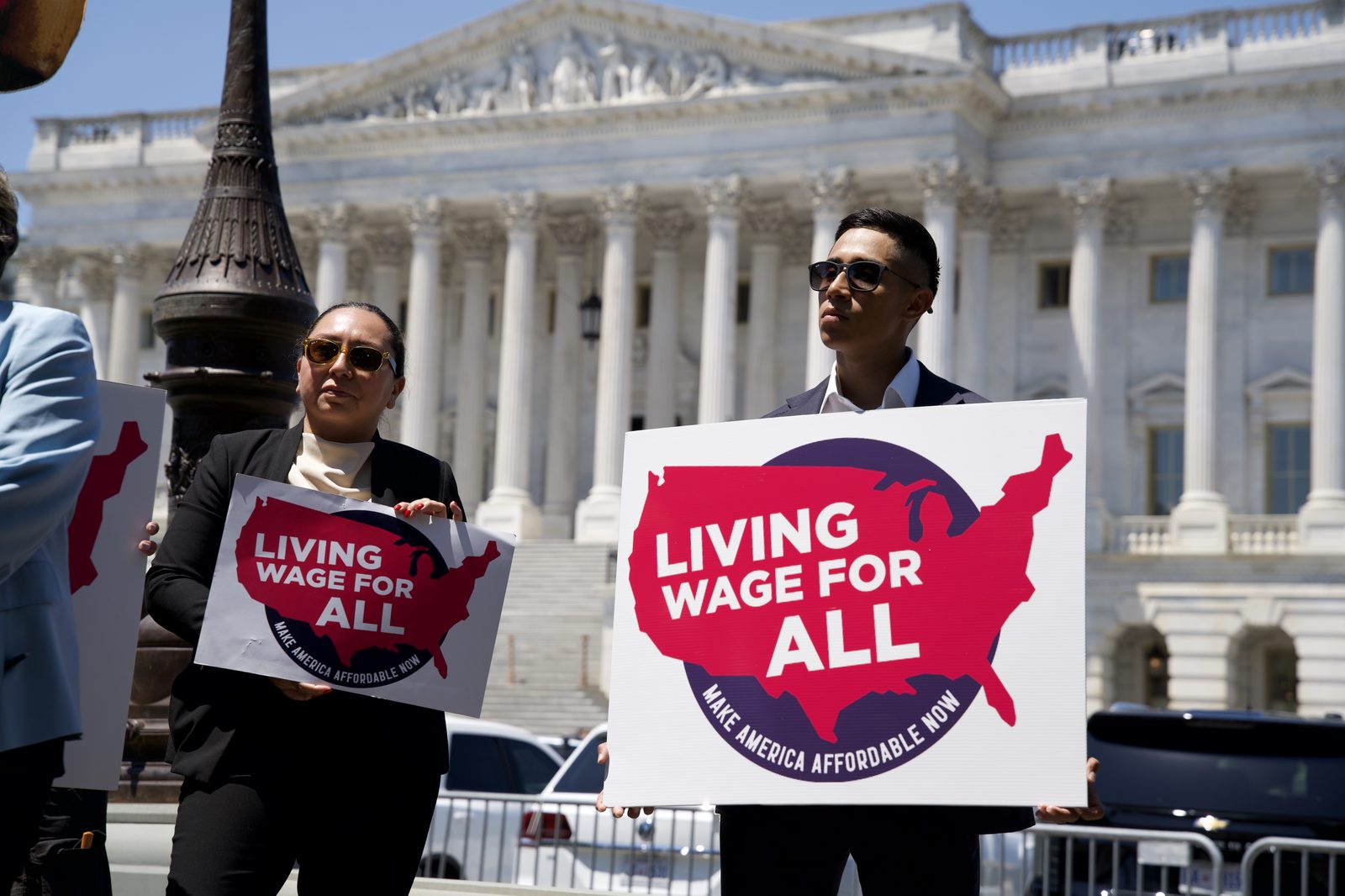
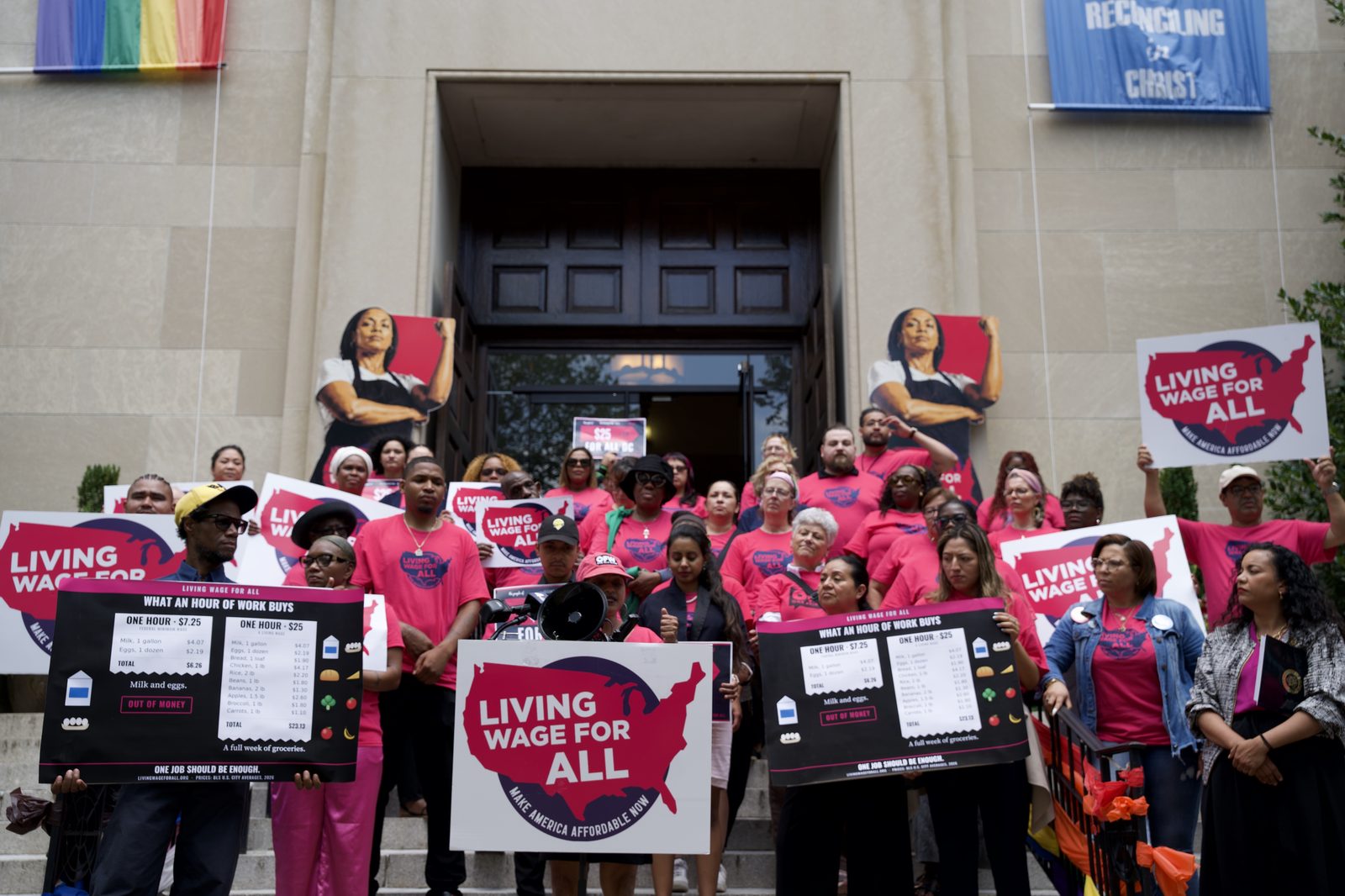
“We’re not asking for a handout. We’re asking for what’s fair, what’s right… Work must mean a livable wage for all.” — Rep. Jonathan Jackson (D-IL-01), $7.25 vs. $25 Grocery Giveaway, June 29, 2026
Coalition partners from across the country gathered in Washington D.C. for the second annual LW4A convening — three days of strategy, training, and mobilization. Day one (June 27) was the “Mobilize & Connect” working session for attendees; days two and three moved the coalition into planning the rest of the 2026 cycle and the run-up to 2028.
Sen. Murphy Makes the Case for $25.
Sen. Chris Murphy sits down for an extended conversation on why a $25 federal minimum wage is the fight now — and why it can win.
Watch on YouTube →The steering committee
Five national organizations lead LW4A:
One Fair Wage
National restaurant and service worker organization. 300,000 members. Convener and operational lead of the coalition.
NAACP
The nation’s oldest civil rights organization. Anchors the racial-equity case — the subminimum wage is documented as a direct legacy of slavery.
PolicyLink
National research and action institute on racial and economic equity. Builds the policy infrastructure behind the federal bill and the state campaigns.
National Education Association (NEA)
The country’s largest labor union. 3 million members. Brings the educator and public-sector worker base to the living-wage fight.
Center for Popular Democracy
National network of local organizing groups. Drives the on-the-ground state campaign infrastructure.
See the full coalition on the LW4A site →
Endorsers
Selected national endorsers of the Living Wage For All Act. The full 100+ organization coalition includes labor, faith, civil-rights, disability-rights, education, and immigrant-worker organizations across the country.

… and 80+ additional national, state, and local endorsers.
Endorse the Act at livingwageforall.org →
The state campaigns
LW4A coordinates thirteen state and local campaigns across eleven states and jurisdictions — the same fight, fought at the level where it can actually win first. Each one is winnable. Together they build the federal mandate. Click any campaign to go to its full page on the LW4A site.
New York — $30 statewide
Statewide legislation: the Living Wage For All NY Act (A10507) plus the One Fair Wage Act (A1200B / S415B). Lead sponsors: Asm. González-Rojas, Sen. Jackson.
LW4A New York →Bay Area, CA — $30 ballot
Workers led the signature drive themselves — more than 100,000 signatures, certified by the Registrar July 23, 2026. If passed, it would be the country’s first voter-enacted $30 minimum wage. On September 15 the Board voted 4–0 to place it on the ballot.
LW4A Alameda County →Los Angeles — $30 ballot
Citywide ballot measure for $30/hour. Polling at 58% support, growing under engaged debate. The country’s second-largest city.
LW4A Los Angeles →Washington, D.C. — Initiative 87 (2027)
Building on I-82’s tipped-wage win: Initiative 87 would set a $25/hour minimum wage for all D.C. workers with no subminimum carve-outs. Signature collection underway now for a 2027 D.C. special election. Polling at 80%.
LW4A D.C. →Illinois — $27 statewide
Statewide push to bring the Chicago One Fair Wage model to every restaurant worker in the state.
LW4A Illinois →Baltimore — $25 for all
One in three people who work in Baltimore City — 104,950 of 314,125 — earn less than $25 an hour. The coalition is backing Councilman John Bullock’s bill to phase out the tipped subminimum wage and building support for a $25 city wage floor.
LW4A Baltimore →Maryland — $25 statewide (2027)
Statewide reintroduction planned for the 2027 legislative session, alongside the push to end the tipped subminimum wage. 105,000+ Maryland tipped workers are paid $3.63/hour.
LW4A Maryland →Michigan — $25 for all
Defending the 2024 Supreme Court win the state Supreme Court restored, and building toward a $25 floor with coalition partners.
LW4A Michigan →Pennsylvania — $25 for all
Pennsylvania pays tipped workers a cash wage of $2.83 while the state minimum sits at the $7.25 federal floor. The coalition backs state legislation from Rep. Chris Rabb to abolish every subminimum wage.
LW4A Pennsylvania →Hawaii — Constitutional amendment
Constitutional path to a livable minimum wage tied to cost of living — in a state with the highest housing costs in the country.
LW4A Hawaii →Nome, Alaska — Student-led $25
Juniors and seniors at ANSEP Acceleration Academy and Nome-Beltz High School formed the Nome Living Wage for All Alliance — petition submitted May 21 to raise the local minimum wage to $25 from the Alaska state floor, which rose to $14 on July 1, 2026. The measure has qualified for the ballot.
LW4A Nome →Connecticut — $25 for all
One Fair Wage and state partners are building the statewide push for a $25 floor.
LW4A Connecticut →Rhode Island — $25 for all
A coalition is forming to move the state toward a real living-wage floor — OFW is contributing to the effort. Rhode Island’s $16 minimum is about $9/hour short of what a single adult needs.
LW4A Rhode Island →See all thirteen campaigns on the LW4A site →
Why a coalition
The federal minimum wage has been $7.25 since 2009. The National Restaurant Association — the lobby that has spent four decades blocking every meaningful raise — runs the same three arguments against every state and city campaign, and the same opposition runs in Congress against every federal proposal. The arguments lose when voters actually hear them in engaged debate. The arguments win when they go unanswered.
LW4A exists to answer them. A 100+ organization coalition is not symbolic. It is the operational capacity to run, simultaneously, the federal bill campaign, the state ballot fights, the state legislative pushes, the press strategy, the research case, the worker testimony program, the employer engagement, and the digital field operation — in every state where this fight is live. No single organization, including OFW, has the standing capacity to do all of that. The coalition does.
How to engage
If you are an organization that wants to endorse the federal bill, sign onto the coalition, or co-sponsor a state campaign: endorse the LW4A coalition.
If you are an individual who wants to join the movement and get state action alerts: join Living Wage For All.
If you are a restaurant worker who wants to plug into the OFW side of the fight: become an OFW member — free, with services, legal help, and worker community.
If you are a press contact: see our press page for OFW coverage, or contact LW4A directly via livingwageforall.org.
Same fight. Wider table.
OFW won D.C. Initiative 82 and the Chicago One Fair Wage Ordinance because we organize the workforce hardest hit by the subminimum wage. LW4A is how we make sure every other workforce hit by it is in the room when we end it for good.
Visit livingwageforall.org Endorse the coalition